Top Game Development Trends in 2026: What Studios Should Watch
The game development landscape has shifted fast since this article was first published. What were emerging trends in 2025 are now standard practice, and studios are facing a new set of pressures around AI adoption, cross-platform delivery, production speed, and player acquisition.
AI pipelines are now expected, not experimental. Cross-platform support is the baseline, not a bonus. And with rising costs and tighter competition, studios that do not adapt their development approach are already falling behind.
Whether you are an indie team or a large-scale publisher, here is what is shaping game development right now, and what it means for your next project.
AI-Powered Game Development Is Going Mainstream
In 2026, AI is no longer experimental; it’s foundational. Studios are using AI across the entire development pipeline:
- Procedural generation tools for world-building and level design
- LLMs (like GPT-4o) to auto-generate dialogue, item descriptions, and branching narratives
- AI-assisted animation and rigging workflows
- Predictive analytics for user behavior and monetization optimization
Studios that embrace AI are not just accelerating production, they're reducing costs, improving personalization, and future-proofing their pipelines.
AI-powered processes in use
Accelerate your game build time
Cut costs and improve qualityBook a CallWhy it matters:
Game studios that integrate AI effectively are shipping faster, testing more frequently, and iterating based on real-time feedback, gaining a significant edge in both time-to-market and product quality.
Cross-Platform Play Is Now the Default
Gone are the days of platform exclusivity. In 2026, players expect a seamless experience across mobile, PC, console, and even web.
Studios are now designing for cross-platform functionality from day one with unified progress, shared inventories, and synchronized multiplayer systems.
What’s driving this:
Cross-platform support boosts engagement, widens reach, and reduces user acquisition costs. And with tools like Unity, Unreal Engine, and backend-as-a-service platforms becoming more robust, the barriers are lower than ever.
Building a cross-platform game?
We’ll help you craft seamless unified gameplay
Across mobile PC and console audiencesGet in touchThe Rise of Social-First Games
From Among Us to Hamster Kombat, social-driven games are dominating user engagement. In 2026, studios are shifting focus from graphics and features to social virality and community mechanics.
Features like:
- Built-in voice or video chat
- Guilds, clans, and group missions
- Live events and UGC (user-generated content)
...are no longer “nice-to-haves” — they’re essential.
Key takeaway:
Studios that design games as social platforms not just content experiences, will drive higher retention and organic growth.
Web3 and Tokenized Rewards: Slowly but Surely
While the crypto hype wave has cooled, blockchain-backed systems are maturing. In 2026, we’re seeing more studios quietly integrating tokenized economies - not as the main attraction, but as value-add layers.
Think:
- Ownership of in-game items
- Real-money trading in curated marketplaces
- On-chain achievements that move with the player
The most successful Web3 games in 2026 don’t market themselves as “crypto games” - they lead with gameplay and use blockchain to enhance engagement and economy design.
Curious about Web3 minus the crypto noise?
Get clarity on your project budgetLet’s talkModular & Scalable Backends Are a Priority
Live service games require more than great code; they need reliable infrastructure. Studios are increasingly adopting scalable backend frameworks to support real-time multiplayer, live ops, personalized offers, and A/B testing.
With tools like PlayFab, Photon, and custom backend solutions, studios are ensuring performance at scale without overengineering early builds.
Pro tip:
Build your architecture to scale, but don’t overspend in pre-revenue phases. Modular backends help you launch lean and expand efficiently.
Shorter Production Cycles, Faster Market Testing
Instead of three-year development cycles, studios are moving toward leaner MVPs and faster iterations. Why? Because market data is more valuable than opinions and games that adapt quickly win long-term.
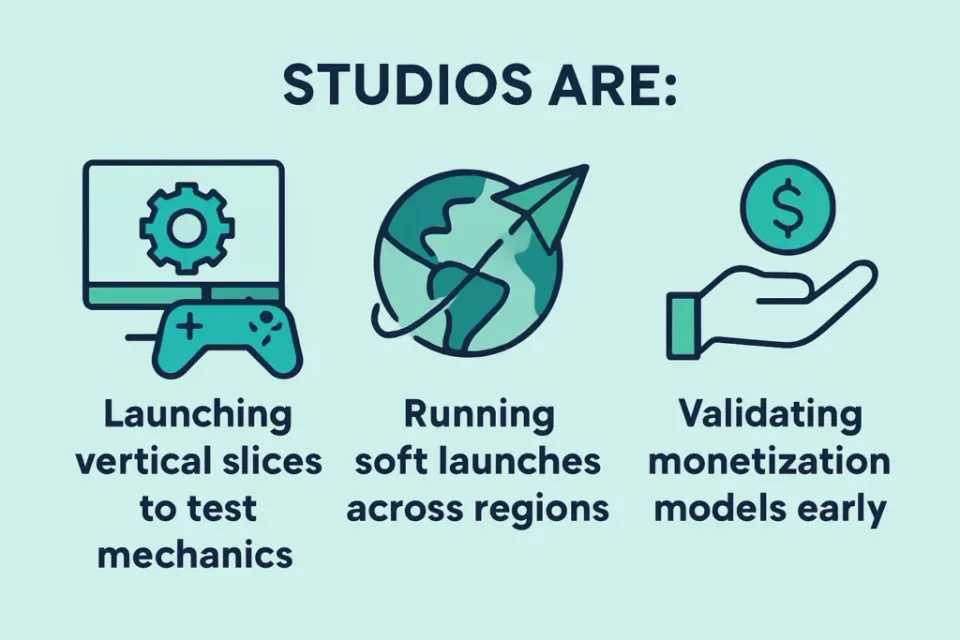
Studios are:
- Launching vertical slices to test mechanics
- Running soft launches across regions
- Validating monetization models early
This trend aligns with the growing role of product managers in game teams and the adoption of agile methodologies borrowed from SaaS.
AI Search and Discovery Are Changing ASO
In 2025, how players find your game is changing. Traditional App Store Optimization (ASO) is being replaced (or augmented) by AI search behavior. Platforms like ChatGPT, Gemini, and voice-based assistants are becoming discovery engines.
That means your marketing content - landing pages, trailers, descriptions - needs to be:
- Answer-ready for AI models
- Structured for semantic search
- Transparent about gameplay loops and monetization
Strategic shift:
Studios must optimize not just for players but for how players ask about games in AI-powered ecosystems.
Launching a new game?
Or scaling what you’ve already built
Let’s make it future ready and trend alignedContact usFinal Thoughts: Adaptability Wins
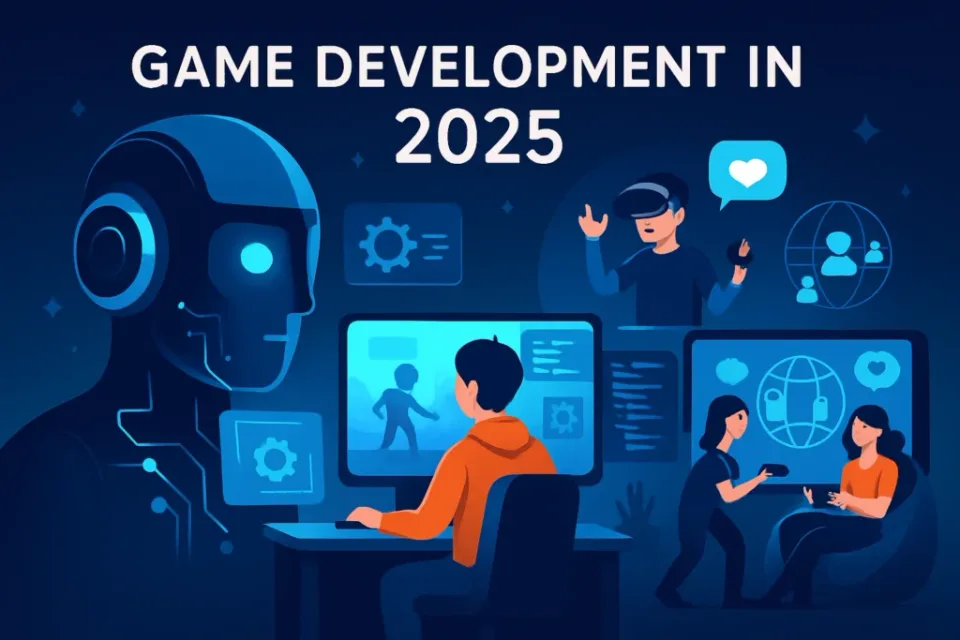
The game development world in 2025 rewards studios that build smarter, not just bigger.
Whether you’re co-developing with an external partner or scaling your internal team, focusing on agility, social design, AI workflows, and platform flexibility will set your studio apart in a saturated market.
At Whimsy Games, we work with studios across genres and platforms to bring future-proof game ideas to life, blending creativity with the latest tech. If you're planning a new title or looking to scale an existing one, let’s talk.

Written by
Daria HoloskokovaMarketing Team Lead
I am an energetic Marketing Executive currently making waves at Whimsy Games, where my path is filled with vibrant growth and innovative strides. In this dynamic world of game development, I lead pivotal marketing strategies that have notably elevated our brand's visibility and successfully attracted essential Marketing Qualified Leads. My involvement is crucial in executing precise digital campaigns and developing compelling content, while also building strong partnerships with vendors and effectively working with various teams within our company.